

LATTICE 200EC7: Haruomi Hosono's hidden video game soundtrack
The story of Haruomi Hosono's obscure contribution to video games, which has been right under our noses for decades.


For the members of the trailblazing technopop crew Yellow Magic Orchestra, video games have always been a potent influence. The legendary group—superstars of their day in Japan, but now renowned the world over for influencing a variety of genres—famously sampled sounds from the arcade games Circus and Space Invaders on their self-titled 1978 debut album in a pair of interludes entitled “Computer Game,” being the first to ever do so on a major record. The three of them were hooked on arcade games, hitting up coffee shops and restaurants in Tokyo to play them whenever they could. “I didn’t know where they were from,” YMO member Haruomi Hosono told the Red Bull Music Academy in a 2014 interview, “but as a techno musician, I felt close to that industry.” Learning that his favorite arcade games were, in fact, products of Japan only served to deepen his appreciation for the medium. “I felt really excited by that and played those games a lot,” he said. “Day in and day out.” The title of the track “Technopolis” from YMO’s 1979 crowning achievement Solid State Survivor was a nod to the burgeoning spread of technology that was transforming daily life in Tokyo—part of that, of course, was the rapid proliferation of video games.
The influence would prove to be cyclical; Yellow Magic Orchestra’s forward-facing electronic music boldly made use of cutting-edge technology. Their use of the Roland TR-808 drum machine, which appeared for the first time on any album in 1981’s BGM—would inspire a generation of video game composers to push themselves to new heights. Chrono Trigger composer Yasunori Mitsuda, Final Fantasy Tactics composer Hitoshi Sakimoto, and Animal Crossing composer Toru Minegishi are among many that hold the group in high regard. Minegishi would slyly reference Yellow Magic Orchestra in the Animal Crossing series with a track called “K.K. Technopop,” using the term initially coined to describe YMO’s music in the late ‘70s. Sakimoto heaped praise on the group in an interview with Nintendo Life, saying that “Thousand Knives” is his first example of a song he wishes he had written himself. Yellow Magic Orchestra gave to the medium of video games just as much as they borrowed from it.
Even after going their separate ways due to creative differences making it difficult for them to keep working together, the members of YMO would continue to play around with the sounds of games. Following the group’s 1983 swan song Service (until their reunion album Technodon ten years later), Haruomi Hosono entered one of the most productive periods of his career. He would compose music for department stores, art exhibits, ballets, and, notably, an anthology of music from arcade games. You’d be forgiven for thinking the music contained within Hosono’s 1984 album Video Game Music is simply audio collected directly from games, but it’s something far more impressive: a recreation of music from video games, made only with a synthesizer. The tracks sound shockingly indistinguishable from genuine playthroughs of a handful of Namco classics including Pac-Man, Libble Rabble, and Mappy. Starting screens, gameplay, and high score entry are all featured, offering a vertical slice of the audible experience of getting a quick game in.
Two exceptions were the first track “Xevious” and the final track “Galaga,” which bookended the album with original compositions, using the sounds from those respective titles to make multi-faceted technopop diamonds not unlike what you’d hear on a typical Yellow Magic Orchestra release. That Hosono would give Xevious special attention made sense—it was his favorite video game. “I played it until I could clear the stages,” he said. With these two tracks, a direct line was being drawn from influence to synthesis.
“We were the only ones who gave game music any attention,” Hosono said, and he wasn’t wrong. Yellow Magic Orchestra were the first feature video game sounds on an album of music, and Hosono would be the first to release an album of video game sounds as music. “Normally it’s something that would be considered to be like Muzak, but the music for games like ‘Xevious’ and ‘Super Mario Brothers’ was excellent,” Hosono would say. He wanted to acknowledge that the sound designers for these games, like Hosono, were legitimate composers that deserved to be recognized. “I thought it was a good idea to record their music for posterity,” he said. “It wasn’t very common back then.”
It’s hard to imagine a period of time when the prevailing idea was that video game music wasn’t worth preserving or listening in any context outside of playing a game, but it tracked with the contemporary perception that video games were fleeting entertainment rather than an artistic medium. Hosono’s recognition of video game music would end up being prophetic—both in the change in sentiment that was looming just beyond the horizon, but also in more immediate and material changes to the way video game music was treated. The success of Video Game Music encouraged YMO’s parent label Alfa to create a sub-label called G.M.O. (short for Game Music Organization) only a couple of years later, working closely with companies like Konami, Nintendo, Hudson, Tecmo, and Sega to produce more anthologies of music from video games.
Naturally, having such a close relationship with the music of video games would eventually mean that the members of Yellow Magic Orchestra would compose for games too. Yukihiro Takahashi was the first, composing for the Super Famicom action RPG Neugier in 1993. Ryuichi Sakamoto’s project is more well known: he provided music for the alien life simulator L.O.L.: Lack of Love, released for the Sega Dreamcast in 2000 and developed by a studio of Square Enix defectors called Love-de-lic. It was named for the YMO release Technodelic, director Kenichi Nishi’s favorite album. But what about Haruomi Hosono?


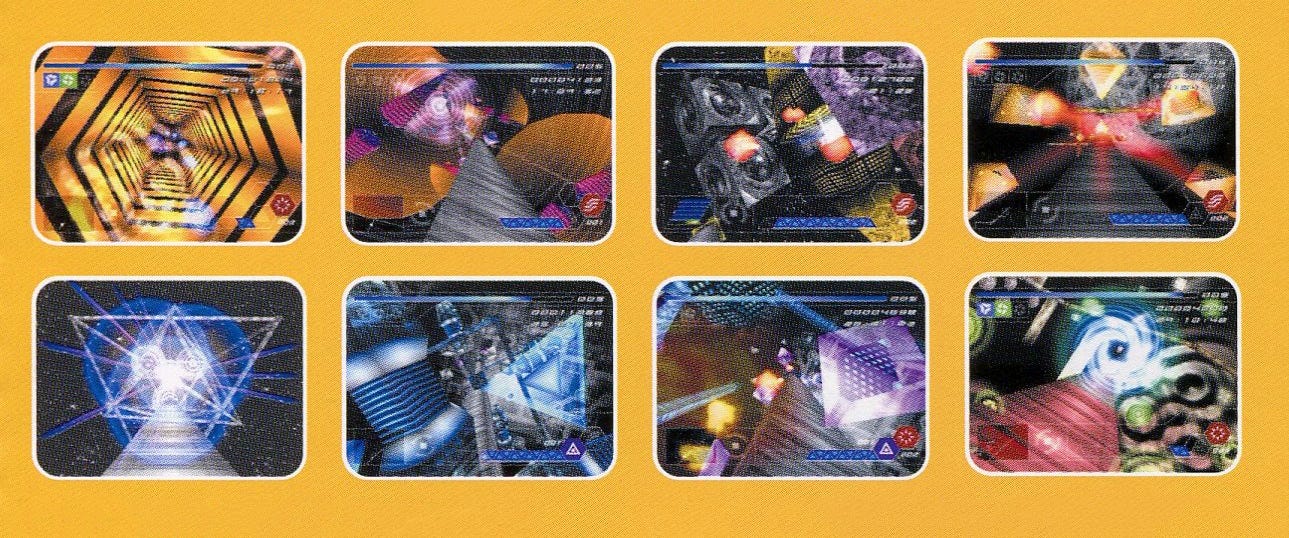
Hosono, too, would contribute his talents to a video game, but despite the fascination he brings to virtually every phase of his long and multitudinous career, the project is rarely discussed. There are a few reasons, and at least one is easy to intuit: LATTICE 200EC7 is very, very obscure. The game, released in 2000 in the comet tail of the PlayStation’s life cycle, was developed by Nousite—a company that still exists, but bowed out of the business of console games not long after LATTICE was released. It’s not a particularly accessible game, either. It’s a weird shoot ‘em up with an on-rails first person control scheme, but with a Kula World-esque gimmick in which you rotate around the rail to navigate through labyrinthine levels. It aims to be an immersive audiovisual experience, something akin to Rez—interesting, but destined to have limited appeal.
Another, more abstract reason for the lack of knowledge of Hosono’s involvement is that he likely doesn’t remember that he even created this music. Feeling such fatigue from being famous that couldn’t be seen in public, Hosono retreated deeper into the shadows following YMO’s dissolution. He turned his attention from the trappings of pop music into something more spacious and formless. “I was adrift in the sea of ambient music,” he said of his time making music in the ‘80s and ‘90s. Some of his most well-regarded music today—like the compositions he made for Muji retail stores in 1984, which have become popular due to spreading like wildfire within YouTube’s algorithm—he claimed in an interview with Vice to have no memory of making. Hosono was hitting the reset button and trying to find his musical center during this time, keeping himself busy by collaborating in strange and unlikely places.
LATTICE 200EC7 is unique for its obscurity despite its place in the oeuvre of a popular artist, but that’s not the only reason it’s fascinating. It possesses a quality that makes it fairly unique: the ability to be appreciated both as a game, and a standalone musical object. The PlayStation’s use of the compact disc format afforded games the ability to have music on a disc in CDDA-quality, and to allow them to be accessible with a CD player. Not all games made use of this, but LATTICE did—meaning that if you owned the game, you also owned a Haruomi Hosono album you could pop into your hi-fi setup.
By the late ‘90s Hosono’s interest was evolving yet again; he was shifting from ambient back to rhythmic forms, though not necessarily similar to the stuff he made with YMO. Following a chance meeting with UK producers Mixmaster Morris and Jonah Sharp at his Quiet Lodge studio, Hosono flirted with more cerebral forms of house and techno, experimenting with dance music that was harder to dance to. The LATTICE soundtrack is packed with complex jungle rhythms, its closest neighbor being 1995’s anxious masterpiece N.D.E. Most of the music on LATTICE is original, though the title screen track has an interesting story unto itself: it was composed for the international 1995 Summer Universiade sporting event and played during the ceremonies. Why he decided to re-use it is anyone’s guess.
Yukihiro Takahashi’s Neugier soundtrack feels a bit like a facsimile of his music in 16-bit; the Super Famicom wasn’t a format he had experience in or that he would return to, and the music seems to suffer from a lack of the full range of dynamics he was accustomed to. Similarly, Ryuichi Sakamoto’s Lack of Love soundtrack, though not as hampered by the Dreamcast’s higher resolution sound, was held back by the GD-ROM format and compressed, unable to be heard in its full glory until it was released as a standalone disc. Haruomi Hosono’s LATTICE 200EC7 soundtrack, however, was uncompromising in sound and scope.
It feels appropriate that the first person to take the initiative to present video game music as something worth considering as its own piece of art would make video game music that could be appreciated both in and out of context with the work that accompanied it. The evolution of technology that inspired Hosono and his friends to make music that sounded like the future enabled him to create something that embodies the respect he shared for video games and music equally. Even today, it feels a little futuristic that the same disc that works in your PlayStation also works in your CD player. If you ever chance upon a copy of LATTICE 200EC7, you should try playing it. Both ways. :) ✿
Thanks for reading this seventeenth installment of once bitten, twice shy.
This piece was originally published for the second issue of Lost in Cult’s Lock-On gaming journal. The magazine is long out of print and I’m still really proud of this piece, so I got their blessing to share it more widely. I’ve done some editing and added even more information.
If you like the newsletter and consider it worth your while, I’d ask you to consider making a donation on Ko-fi! There’s an option for a recurring monthly donation, but even just a one-time helps a lot. Thanks so much for reading!
Thank you for sharing, this was a great read and the OST is fire.
On the topic of game composers inspired by YMO I felt the overwhelming need to bring up my GOAT Shinji Hosoe, whose love of YMO extended past just his compositions to the point he and other composers made a parody band which dropped some legitimate bangers. I still keep their parody/cover of Uwakina Bokura in rotation.
A fun aside, Rydeen was featured on Sega’s 1982 arcade release of Super Locomotive, but that was surely unsanctioned 😆
first