

Mioko Yamaguchi, the princess that never dropped her crown
Unraveling the work of a synth-pop genius before and after a 35 year hiatus.

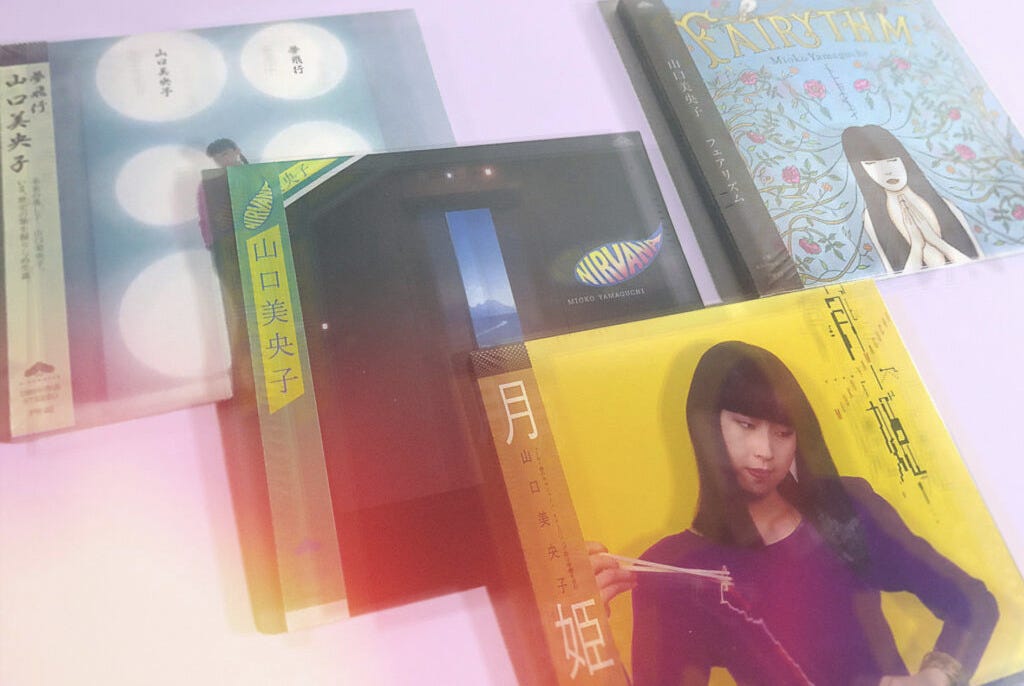
Japanese music is attracting more interest in the Western world than any other point in history. As the internet continues to accelerate and the tools that facilitate communication become more frictionless, music from the archipelago nation finds its way to every corner of the world. A song goes viral in Japan, and it’s only a few clicks away from reaching someone in another country. New music benefits from this interconnectedness, but older music has seen a significant boost too. Famously, Mariya Takeuchi’s “Plastic Love” became a hit via YouTube’s recommendation algorithm, steadily building up a dedicated following of city pop acolytes that sought out similar sounds. Nowadays, it happens even more quickly; Taeko Ōnuki’s “4:00 A.M.” appeared in a few viral TikToks, and overnight hundreds of thousands of new netizens know her name. When I first learned of Mioko Yamaguchi, it wasn’t nearly that easy.
If you were interested in Japanese music in the early 2010s like I was—especially things from the ’80s and ’90s—word of mouth was pivotal. Information spread slowly via blogs and forums, and if you wanted to do your own legwork you had one particularly valuable tool at your disposal: album credits. If you found a record you loved, you would check to see who contributed to it, and then check to see where else their name appeared. Eventually, you developed a mental network to help you understand what to expect from a record once you recognize enough musicians. You find new names, and it’s exciting; there’s suddenly a new breadcrumb trail to follow. (This is still the best way to find music. Discogs is the only website I check every single day.) I started to see Yamaguchi’s name as the songwriter for a handful of catchy idol songs, which caused me to take note. She wrote an ending theme for Ranma ½, one of my favorite anime. When I found that she’d made three albums of her own, naturally, I tracked them down.
Having heard some city pop records from 1980 already (by Ōnuki, Takeuchi, and Tatsuro Yamashita, to name a few), Yamaguchi’s debut record Yume Hiko immediately felt different from the rest; its sonic palette was more synthetic, foregoing the traditional range of session players for a pronounced emphasis on electronics. Yamaguchi wrote and performed every song mostly on her own, bearing less resemblance to her city pop contemporaries and more to techno-pop pioneers Yellow Magic Orchestra, who had burst onto the scene two years earlier. Yamaguchi’s “A Dream of Eμ” in particular reminded me strongly of YMO’s “Tong Poo”—they have the same crystal clear synth tones
That wasn’t just a coincidence; the synthesizers on Yume Hiko were programmed by Hideki Matsutake, who by then had already made a reputation for himself as the best in the business. Matsutake had already contributed to two YMO albums as well as solo projects by members Ryuichi Sakamoto and Yukihiro Takahashi, securing his position as the de-facto fourth member of the group while they were ascending to superstardom. Yamaguchi has admitted in interviews she was enamored with Yellow Magic Orchestra and wanted to get those same otherworldly sounds into her music.
The pair were a natural fit together and continued to work together for Yamaguchi’s sophomore record NIRVANA the following year. This time, Yamaguchi had access to an all-star cast of session musicians. (The Discogs page is an amazing spool of endless threads to tug at.) The compositions got bolder and denser, but even with a more traditional rhythm section and some particularly impressive guitar solos like the one on “Telephone Game,” Yamaguchi’s beloved synth remained the centerpiece. Her affinity for synthesizer, which contrasted uniquely with her demure vocals, earned her the nickname “synth utahime” (a combination of the words song and princess) among her peers. NIRVANA feels like a transitional work for Yamaguchi—a trial ground of ideas, which took the foundation of Yume Hiko and fanned it out in all directions.
Though as great as Yume Hiko and NIRVANA are, neither of them could have prepared me for Tsukihime, her masterpiece. Yamaguchi and Matsutake would continue their partnership, adding Masami Tsuchiya into the fold as an arranger. Tsuchiya, the founding member of synth-pop titans Ippu-Do, brought a critical change to the sound; his arrangements were sparse and open, nudging Yamaguchi’s voice straight into the foreground. Every flourish was important. The instrumentation felt more traditionally Japanese, but the synth became increasingly more alien. Tsukihime sounded unlike any other singer-songwriter record from 1983. Its closest relatives are Ippu-Do’s 1983 opus Night Mirage (which shares its ethereal mystique) and Tsuchiya’s own solo record Rice Music (which similarly adapts Japanese melodies into future-facing synth-pop), but really, it’s in a class of its own.
Now, Yamaguchi stands at an interesting crossroads. Amidst a revitalization of ’80s flavor, she emerged from a 35 year hiatus. With Hideki Matsutake by her side once again, she’s making music that sounds like the natural next step from where she left off. 2019’s Tokisakashima feels sonically more in line with electronic music from the mid 1990s rather than the late 2010s, and that’s for good reason—she’d been playing a lot of Chrono Trigger and wanted to evoke the sonics of its transtemporal themes. Stepping through the corridor of time, she opens a wormhole to a nexus between eras; it could be mistaken for a long lost SquareSoft classic if not for Matsutake’s pristine modern production.
She followed up her grand comeback with FLOMA and FLOMA mini, an album and EP of self-covers, some from her original albums and a handful that she penned for other singers like Yuki Saito and the late Miwa Kawagoe. They’re proof of her commitment to reinventing herself and a test of her arranging skills, adding new and surprising flourishes to a catalog that’s defined a career spanning half her life. She was finally properly warmed up for her third post-revival record FAIRYTHM, a concept album that shares much of its DNA with Tsukihime and feels comparably as bold an artistic statement. She wondered, actually, if it was too niche and nested in its own fantasy world to have much appeal in the modern pop landscape—but it stands alongside her best work from the ’80s.
Coming back to the drawing board with 2025’s Love & Salt, she challenged herself in a new way: making an album in which every song makes its own statement. “These days, people listen to music through subscription services, and they tend to listen to each song individually rather than listening to an entire album from beginning to end,” she said in an interview with Real Sound. “So, I thought this time it didn’t necessarily have to be a conceptual album.” She pitched Matsutake on composing music that sounds like her recent favorites, Sabrina Carpenter and Billie Eilish. That meant eliminating her usual complex counter-melodies, focusing on simpler chords and rhythmic ideas. Of course, it’s Mioko Yamaguchi and sometimes she can’t help herself; “Freya” is densely packed with spacious synth and peculiar percussion, and “Salomé” is stacked with a massive strata of vocals stretching up to the sky.
Even with a bonus disc of classic songs she wrote for others included with Love & Salt, she doesn’t sound like a legacy act gesturing toward her glory days. That’s partially due to Yamaguchi’s forward thinking, but her willingness to interface with her past is working in her favor. During her long hiatus as a solo artist, she kept her pen sharp by lending her talent to younger artists. If anything, it’s a statement that she wasn’t just resting on her laurels; we’ve been hearing from her even when we didn’t know it. Mioko Yamaguchi is pushing into new frontiers, but she hasn’t lost touch with what’s always made her great. ✿
Thanks for reading this eighteenth installment of once bitten, twice shy.
This piece was originally published for the online magazine TOKION, in both English and Japanese! It was timed with the release of FAIRYTHM in 2022, but I wasn’t satisfied with the attention paid to her post-comeback albums. Love & Salt was not covered on the English speaking internet with nearly the enthusiasm it deserved, so I’ve taken the liberty of expanding the piece with quite a lot of new information. TOKION has gone defunct, but I thank them for commissioning the original piece and for giving me permission to update it.
If you like the newsletter and consider it worth your while, I’d ask you to consider making a donation on Ko-fi! There’s an option for a recurring monthly donation, but even just a one-time helps a lot. Thanks so much for reading!
I found this post by looking up Mioko Yamaguchi after listening to her ear catching Nirvana album. Love the info on here, I hope its ok I link this post on a Rateyourmusic.com review I did of the Nirvana album.
Thank you for sharing! Yume Hiko and Tsukihime used to get so much play from me back in college, but I am embarrassed to say that I didn't know Yamaguchi had started making music again. You are right that these recent albums did not get the hype they deserved (at least in the English speaking world...), I'm looking forward to listening!
I deeply relate to religiously reading through credits to find a new lead on what to listen to. I remember having this theory that, basically any good music coming out from Japan from the 70s onwards had YMO DNA given how often I would see them and/or their collaborators in the credits lol. Ofc this was also all done online, not as romantic as flipping through a LP jacket... Still in the algorithm era of music it is probably still worth going down a discogs rabbit hole or two to find some cool new stuff.
Looking forward to reading the next one!